
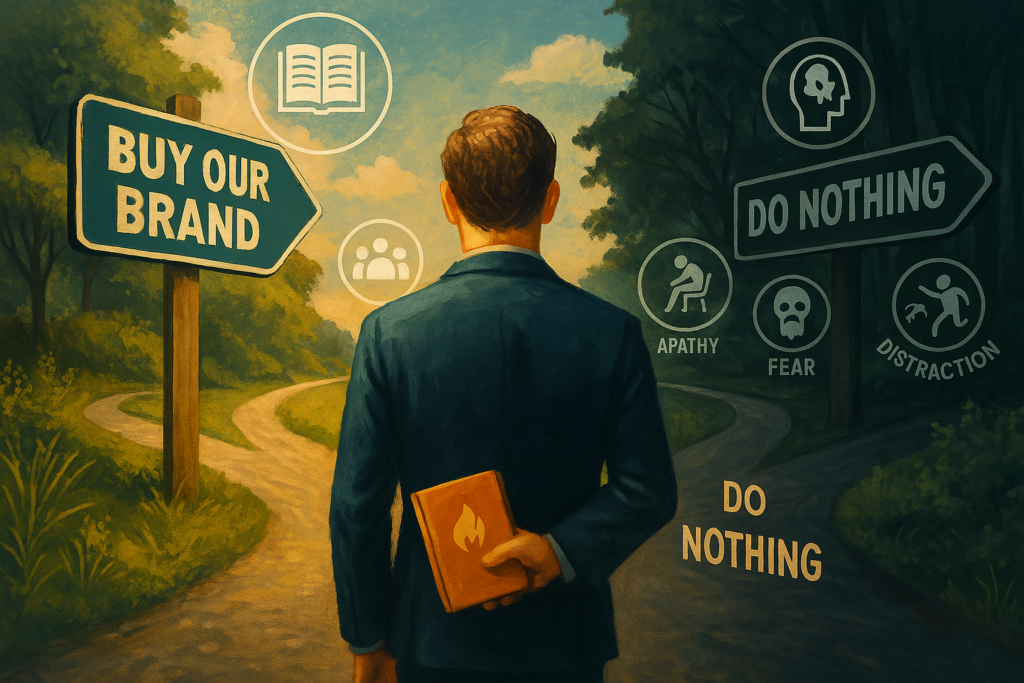
We’ve spent the past decade building marketing strategies around direct competitors.
Tech against tech. Coffee against coffee. Football clubs against football clubs.
But what if that’s the wrong fight entirely?
The brands that will thrive in 2025 and beyond aren’t the ones outpacing their category rivals.
They’re the ones that recognise the game has changed — and that your most dangerous competitor isn’t the business next to you on the shelf. It’s the one stealing your customer’s energy, attention, and belief in change.
Stop Thinking in Categories
Marketers love categories. They feel neat. We map journeys, analyse competitors, build personas.
But consumers?
They operate in messy, emotional, context-rich environments where “alternative to” doesn’t always mean “similar to.”
When someone decides not to go to the gym, they don’t choose a different gym.
They choose Netflix, or a glass of wine, or simply staying put.
When a small business decides not to invest in marketing, they’re not picking a different agency.
They’re picking caution. Overwhelm. Fear of looking stupid.
In behavioural economics, these hidden obstacles are called “counterfactuals.”
In brand strategy, we should call them the real competition.
Who You’re Actually Competing Against
Let’s reframe this for three different types of businesses:
- A Fintech App
You’re not competing with Revolut. You’re competing with status quo bias.
With your customer’s fear of giving up control. Their dread of changing habits. - A Football Club
You’re not just competing with other clubs. You’re competing with the sense that “nothing ever changes” and “we’re not going anywhere.”
You’re fighting apathy. Resignation. Family obligations. Rain on a Friday night. - A B2B SaaS Platform
Your rival isn’t just another dashboard. It’s decision fatigue. The internal politics of procurement.
The effort of convincing a sceptical boss.
The idea that doing nothing is safer than doing something.
In each of these cases, the real challenge isn’t beating the market leader.
It’s helping the customer overcome the internal inertia that stops them acting at all.
Your Competitor Might Be Emotional, Not Rational
Rory Sutherland often reminds us that “a flower is a weed with an advertising budget.”
That is: perception changes everything.
So what if your biggest competitor isn’t another product — but a feeling?
- Confusion (“I don’t get what this is for.”)
- Scepticism (“I’ve been burned before.”)
- Apathy (“It’s just easier not to decide.”)
Behavioural science is crystal clear on this:
🔹 People are loss-averse.
🔹 They resist uncertainty.
🔹 They overweight the effort of change and underweight the benefits.
Your strategy must reflect that. Because if you’re only focused on differentiation within your category, you’ll miss the hidden reasons people don’t buy anything at all.
What to Do Instead: Compete for Belief
So how do you build a brand that competes against the real enemy?
1. Reposition Inaction as the Riskier Option
Don’t compare yourself to the competition. Compare yourself to the consequences of doing nothing.
🔸 “If we don’t act now, we fall behind.”
🔸 “Still managing that manually?”
🔸 “How much is waiting costing you?”
2. Use Storytelling to Disrupt Default Bias
Instead of logic and features, tell stories of transformation:
🔹 “They were stuck. They chose us. They never looked back.”
Stories make change seem safer. Possible. Desirable.
3. Create a Sense of Cultural Movement
We are more likely to act when we feel part of something bigger.
Whether it’s a football club’s vision, a fintech’s community, or a B2B product’s momentum,
People move when they believe others are moving too.
As Seth Godin says: “People like us do things like this.”
That’s not just marketing. That’s gravity.
Final Thought: Don’t Compete for Comparison. Compete for Commitment.
Consumers don’t open a spreadsheet and compare ten options side by side.
They respond to mood. Friction. Stories. Timing. Trust.
And that means the best brands don’t just win the category.
They redefine the context in which decisions are made.