
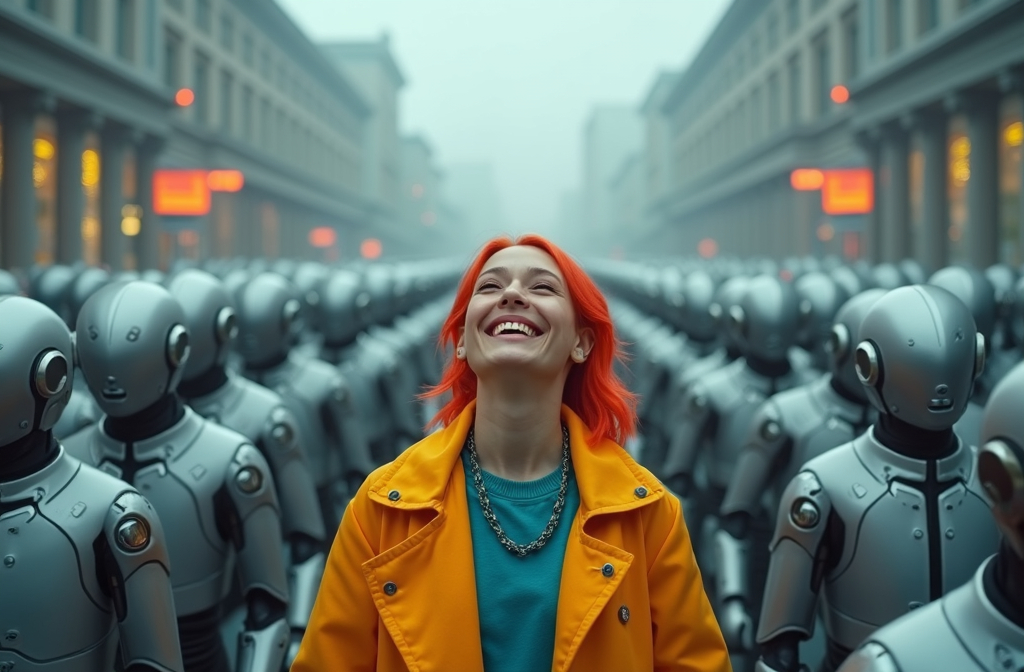
There is, in marketing circles, a growing sense of existential panic about artificial intelligence.
Not because it’s supremely intelligent, but because it’s worryingly competent at producing things which are, for the most part, just about good enough.
We worry that AI will steal our jobs.
In truth, it will only steal the jobs that deserved to be stolen, the ones that were already halfway to being replaced by a series of LinkedIn bullet points and a Canva template.
If AI can do your job, the problem wasn’t the intelligence of the machine.
The problem was the predictability of the human.
We Don’t Collapse Through Catastrophe. We Drift Through Inertia.
Behavioural science has long understood that we overestimate catastrophic risks and underestimate the slow, insidious dangers of complacency. We are the frog of the boiled frog experiment. We’ll jump out of the boiling water of sudden disaster, but we’ll remark on how ‘the bath is a bit warm’ as we’re slowly boiled in incremental malevolence.
We picture innovation ending in a cataclysmic robot uprising, whereas the real danger is the quiet, polite death of imagination under the reassuring tyranny of efficiency.
It is not destruction we should fear.
It is drift.
Because when AI is good enough to generate endless acceptable outputs, the gravitational pull towards safe, dull, and forgettable becomes irresistible.
If you thought the era of lowest-common-denominator content was bad, wait until the denominator is produced at infinite scale and zero cost.
Good Enough Becomes the New Graveyard
We are already seeing the early symptoms.
The endless articles that say almost everything — but nothing memorable.
The avalanche of perfectly fine, utterly indistinguishable ads.
The polite, frictionless, forgettable user journeys that leave no impression whatsoever.
AI did not kill creativity.
It simply made it easier to choose the mediocre default.
As behavioural economists would point out, default options are remarkably powerful, not because they are loved, but because they are easy.
In a world of infinite choices, the easiest choice wins.
And when the easiest choice is “generate acceptable content with a click”, well, what a perfectly convenient path to complete brand invisibility.
Who Will Survive?
It won’t be the brands with the biggest tech stack or the most impressive dashboards.
It will be the brands who remain interesting — defiantly, gloriously, irrationally INTERESTING.
Brands who understand that AI can assist, but it cannot astonish.
That automation can produce quantity, but not quality.
That human attention, once lost to boredom, is extraordinarily expensive to recover.
As Seth Godin has said: “Shipping work doesn’t mean shipping garbage.”
And as Rory Sutherland might remind us: “If you never test anything odd, you’re testing nothing important.”
A Playbook for the Bold (and the Slightly Mischievous)
- Overcorrect for weirdness. If an idea feels safe, it’s already halfway to being ignored.
- Design for emotional friction. Surprise, delight, curiosity — these are not inefficiencies; they are necessities.
- Reward bravery, not just results. It is better to try something memorable and fail than to succeed at being forgettable.
- Use AI for scaffolding, not storytelling. The hammer builds the house; it doesn’t decide what kind of house you want to live in.
- Default to curiosity, not certainty. The moment you believe you know everything, your audience knows they can stop paying attention.
Final Thought
AI will not be the death of marketing.
Being Boring will.
If marketing is to survive as a creative, strategic force, it must resist the silent seduction of adequacy.
“The worst thing about humans isn’t that they are irrational. It’s that they are predictable.”
The brands that thrive won’t be the ones who automate the fastest.
They’ll be the ones who remember that the greatest competitive advantage is still being interesting.
Be useful. Be unexpected.
But above all, be human.

