
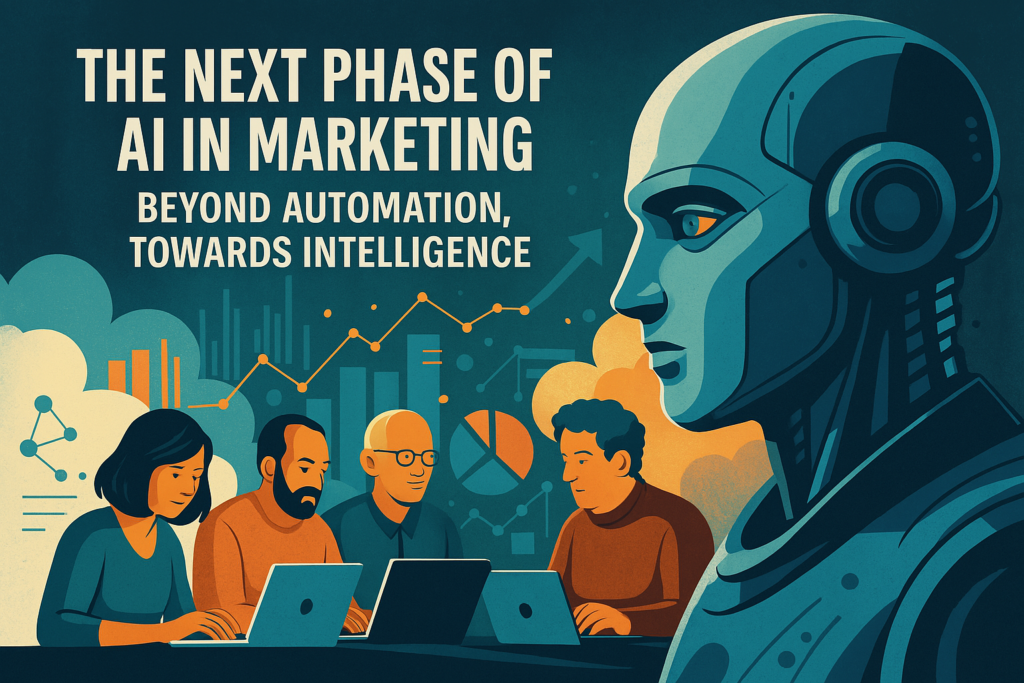
Introduction: The AI Illusion
For years, the mere mention of AI in marketing was enough to cause a frenzy. It was marketed as the ultimate solution – an omniscient entity that would predict consumer behavior, automate content, and optimize every ad placement with ruthless efficiency.
And for a while, that was true. AI-powered marketing was a massive differentiator – until it wasn’t.
Fast-forward to 2025, and the landscape has changed dramatically. Everyone has access to AI. Every brand has an automation strategy. Every marketing department is using machine learning to refine its targeting.
And yet, despite this algorithmic arms race, consumer engagement isn’t skyrocketing. In fact, many brands are finding it harder than ever to create genuine differentiation.
Why? Because AI, for all its computational brilliance, has been used as a shortcut rather than an intelligence amplifier.
The smartest brands in 2025 won’t just automate faster. They’ll think smarter. The next phase of AI isn’t about replacing humans – it’s about making humans more powerful.
1. AI is Brilliant at Making Decisions, But Terrible at Asking the Right Questions
AI is like a hyper-efficient GPS navigation system – it will get you to the optimal destination as fast as possible.
But what if the destination itself is wrong?
🔹 Case Study: The Automation Trap
Over the past few years, we’ve seen AI-driven performance marketing reduce costs, improve conversions, and optimize ad spend. But in doing so, it has reinforced short-termism – optimizing for immediate engagement while failing to build long-term brand equity.
Facebook, Google, and TikTok’s ad platforms reward content that generates the most engagement, meaning brands have ended up creating short-term dopamine loops rather than meaningful customer relationships.
🔸 Example: A fashion brand using AI-powered dynamic creative testing might find that an ad featuring outrageous headlines or exaggerated claims drives the highest engagement. AI will double down on this – but does that mean it’s actually the best long-term strategy?
🚨 AI is superb at optimization, but terrible at asking: “Should we even be optimizing for this?”
Key Takeaway:
“AI will make a suboptimal decision with maximum efficiency. The real winners will be those who use AI to amplify judgment, not replace it.”
2. From Automation to Augmentation: How AI Will Make Marketers Smarter, Not Redundant
The great fear of the past few years was that AI would replace marketers. It hasn’t.
Instead, AI is shifting from being a tool of automation to a tool of augmentation – enhancing human creativity, decision-making, and strategic thinking.
🔹 The Shift from AI-led Marketing to AI-assisted Creativity
- Old AI: Automating ad placements, email sequences, and chatbot responses.
- New AI: Assisting with behavioral insights, idea generation, and customer psychology.
🔸 Example: A brand using AI to predict what emotions drive purchasing decisions rather than just optimizing which color button gets clicked most.
The next phase of AI will be less about automation and more about intelligence augmentation. The difference?
✅ Automation replaces tasks.
✅ Augmentation improves human capabilities.
Key Takeaway:
“AI is the intern, not the CEO. It can crunch numbers, but it cannot understand what makes a brand irresistible.”
3. The Death of “Data-Driven” Decision-Making (and Why Context is Everything)
For years, marketers were told to be data-driven. It sounded impressive. It sounded scientific.
The problem? Data without context is useless at best and misleading at worst.
🔹 Example: The Netflix Paradox
In 2013, Netflix had a massive AI-driven recommendation engine. It could predict what people wanted to watch based on past behavior. Yet, when they launched House of Cards, it was not because the data said so.
It was because a human made an intuitive, strategic bet – recognizing that there was a gap in political drama that could capture cultural relevance.
📌 AI didn’t predict the success of House of Cards. A human did.
🔸 The lesson? AI is brilliant at detecting patterns but terrible at recognizing cultural moments, emotional resonance, and gut-feeling opportunities.
✅ 2025’s best marketers will be data-informed, not data-driven.
Key Takeaway:
“Data can tell you what happened, but only judgment can tell you why it matters.”
4. AI Will Dominate Execution, But Humans Will Win Strategy
There is no doubt AI will revolutionize execution – content creation, automated insights, and real-time customer interactions.
But AI does not understand humor, emotion, or cultural nuance – which means the brands that rely on AI alone will feel robotic, predictable, and devoid of personality.
🔹 Example: AI vs. Behavioral Science in Ad Copy
AI-generated content will optimize for engagement, but behavioral science will optimize for persuasion – which is a very different thing.
A human copywriter knows that an ad reading “Don’t Miss Out – 50% Off” plays on loss aversion, triggering urgency.
AI might not recognize that phrasing it as “This deal won’t be here tomorrow” might perform even better – because it taps into temporal discounting biases rather than just discount-seeking behavior.
The best marketers in 2025 will know when to listen to AI – and when to ignore it.
Key Takeaway:
“AI will give you the best-performing ad. A great strategist will make it unforgettable.”
Conclusion: The Next Era of AI in Marketing
For years, the conversation has been “Will AI replace marketers?” But this was always the wrong question.
AI will not replace marketers.
AI will replace marketers who don’t understand how to use it properly.
The brands that thrive in 2025 will be the ones that:
✅ Use AI to augment human creativity, not replace it.
✅ Focus on behavioral insights over raw data.
✅ Combine intuition with machine learning for smarter decision-making.
🚀 The future of marketing isn’t AI-led. It’s AI-assisted.
Final Thought:
“AI can tell you which headline works best. But only a human can write a headline that makes someone feel something. And in the end, it’s feelings – not algorithms – that drive great marketing.”
What’s Next?
AI has changed marketing forever – but are brands using it to think smarter, or just optimize faster?
Would love to hear your take – is AI making marketing better, or just making bad marketing more efficient? Drop your thoughts below. 👇

